
Click the button to start reading
Conflict That Moves the Needle: Turning Tension Into Breakthrough Ideas
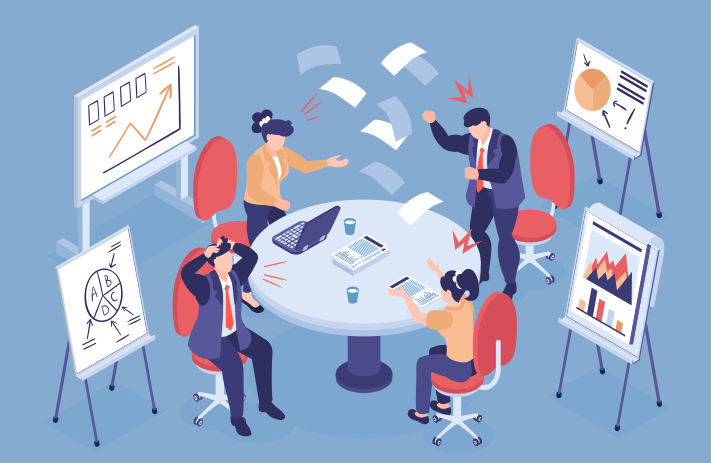
You know the feeling: opinions spar, cheeks flush, the room’s oxygen thins—everyone glances at the clock or the mute button.
But inside that prickly moment sits pure possibility. When you teach your team to handle heat without hiding, you unlock raw creative voltage, sharper strategy, and loyalty that only forms when people fight for results together.
This playbook doubles down on the original framework—packing twice the stories, scripts, and step-by-step rituals so you can turn each disagreement into a launchpad for innovation.
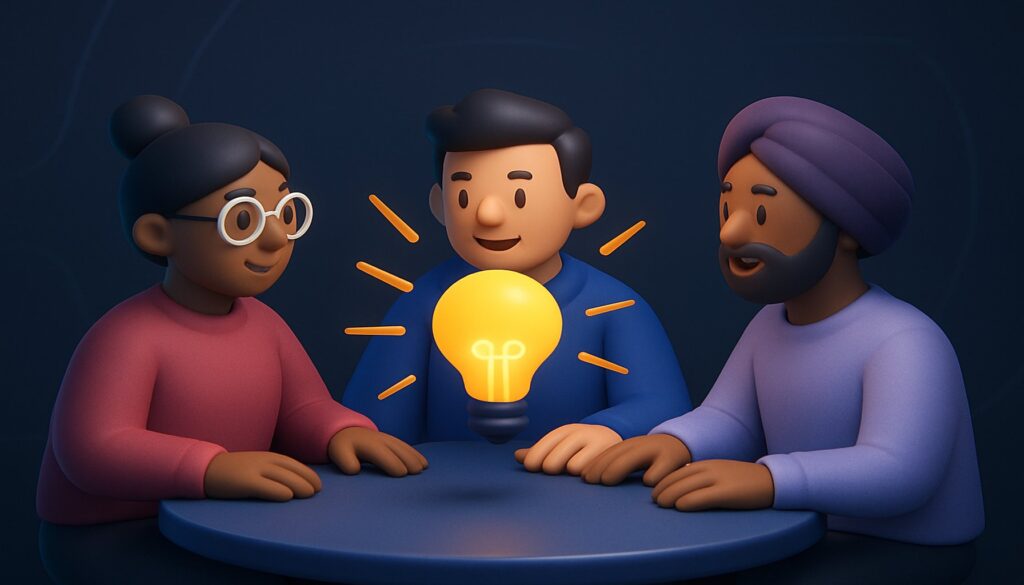
1. Reframe Conflict as Creative Voltage — And Say It Aloud.
Your nervous system reads conflict as danger. Adrenal glands squeeze cortisol, tunnel vision kicks in, and suddenly you’re defending turf instead of chasing truth. The fastest antidote?
Name the discomfort before it hijacks the room. Neuroscientists call this “affect labeling”—putting words on an emotion siphons power from the amygdala and returns it to the prefrontal cortex where reasoning lives.
- Open with “voltage language.” Try: “If sparks fly today, that’s the sign we’re close to a breakthrough. Let’s mine them.”
- Visual cue. Post a lightning-bolt icon on slides or a sticky note on your webcam. Every time conflict shows up you tap the note and say, “Voltage sighted—keep going.” The habit rewires threat into opportunity.
- Fast reward. After a spicy debate, publicly thank the dissenters: “That pushback saved us four sprints.” You prove disagreement equals professional capital.
“Innovation rarely strolls out of consensus; it erupts where perspectives collide.”
🧠 Brain-hack bonus: Ask everyone to take one slow belly breath when voices escalate above baseline.
A single diaphragmatic inhale lengthens the exhale, flips the vagus nerve switch, and returns blood flow to higher-order thinking—no lava-lamp or Zen app required.
2. Spot Four Dimensions of Conflict Health
Traditional training paints conflict as productive vs. destructive. Helpful, but too binary. You need a richer dashboard, so use the “F.E.R.E.” lens—Focus, Energy, Respect, and Exit.
a) Focus ▶︎ Issue vs. Identity
If commentary targets ideas (“Timeline B lacks buffer”) you’re safe. If it targets identity (“You never plan ahead”) you’re in the danger zone.
b) Energy ▶︎ Centered vs. Chaotic
Look for controlled intensity—animated voices with full sentences and listening pauses. Chaotic energy sounds like cut-offs, side chatter, or the dreaded Zoom un-mute pileup.
c) Respect ▶︎ Candid vs. Contemptuous
Candor challenges viewpoints while honoring competence. Contempt shows up as eye rolls, sarcasm, or smirk-emoji comments in chat.
d) Exit ▶︎ Resolution vs. Residue
Healthy conflict ends with owners and next steps. Toxic conflict ends with polite silence that later shows up as Slack side-DMs and hallway sighs.
3. The SAFE Framework—Expanded With Micro-Scripts
The SAFE scaffold rescues ideas trapped under politeness. Here’s a deeper dive with ready-to-copy phrases:
S — Signal Curiosity
“I’m noticing two strong schools of thought. Can we press pause and surface both?”
A — Ask Open Questions
“What assumption sits under your position?”
“How might this land with our most skeptical customer?”
F — Frame Common Ground
“Seems we all want a launch before Q3 and a friction-free user flow. Agree?”
E — Establish Next Step
“Great. Mia, you’ll prototype the lightweight flow by Friday; Chris will mock legal impacts. Reconvene Tuesday.”
Remote adaptation: Drop these prompts in a Teamly thread so introverts mull asynchronously while extroverts cool down. The software’s tidy timeline keeps narrative coherence even when debate spans time zones.
SAFE in 90 Seconds — The “Elevator Tweak”
- 20 sec: “Voltage spotted—what views haven’t surfaced?”
- 30 sec: Each camp gives elevator pitch (no rebuttals).
- 20 sec: Group names overlap.
- 20 sec: Facilitator assigns who will validate or test each key risk.
Even complex strategic battles become a brisk, repeatable cadence.

4. Facilitate Heat Without Getting Burned
Facilitation isn’t about neutralizing tension; it’s about using it as jet fuel without melting the wings. Equip yourself with these six moves:
- Time-box the Storm (again). Twelve minutes feels oddly perfect—enough for depth, short enough for urgency.
- “Microphone Object.” In-person? Use a stress ball. Virtual? Use a 🌟 emoji next to the speaker’s Zoom name. Everyone else stays on mute until 🌟 passes.
- Translate Emotion to Criteria. When someone blurts, “This feels reckless,” ask, “Which metric would tell us it is reckless?”
- Draw the Fork. Quick two-column sketch: pros/cons, upside/downside percentages. Visual clarity lowers drama.
- Surface the Ghost. Many fights echo an unsaid anxiety—brand damage, job security, legacy tech debt. Ask, “What risk are we whispering about but not naming?”
- Re-cap in Writing. Right after the meeting, drop a 5-sentence summary in Teamly: decision, dissenters heard, remaining open questions, owners, deadlines. Written closure dampens rumination.
Bonus for hybrid teams: Let remote members type in parallel on a shared Google Doc while in-room voices debate. The silent writing slows adrenaline and makes invisible cognition visible.
5. Bake Healthy Conflict Into Rituals, Rewards, and Rules
Culture happens when behaviors repeat without permission. Embed conflict-positive behaviors until they’re muscle memory.
5.1 Debate Fridays (30 min)
Every Friday at 3 p.m., one teammate volunteers a controversial stance. The job? Provoke. The group? Probe. The outcome? Documented insights and next steps. Over time the slot turns tension from surprise to scheduled creative cardio.
5.2 Devil’s Advocate Cards (Physical or Digital)
Print three red cards; in Teamly tag them with 🃏. Anyone can play a card once per meeting, forcing the group to argue the opposite for two minutes. Artificial dissent immunizes you against real blind spots.
5.3 Conflict Post-Mortems
Right after product launches or campaigns close, debrief not only metrics but moments when conflict fueled quality—or where avoidance sabotaged speed. Capture in a shared wiki so new hires learn from historic tension.
5.4 Recognition for Rigor—not Niceness
During all-hands shout-outs, praise behaviors like “asked the scary question,” “poked holes in a beloved prototype,” or “modeled calm dissent.” Psychological safety deepens when bravery, not harmony, gets airtime.
6. Equip Individuals With a Personal Conflict Toolkit
Frameworks help teams; skills help humans. Hand every employee a simple toolkit so they walk into tension prepared:
- 90-Second Body Reset. Stand, roll shoulders, inhale for four counts, exhale for six. Somatic calm buys cognitive space.
- Steel-Manning. Summarize your opponent’s view so clearly they say, “Yes, that’s exactly it.” Only then do you rebut. Forces deep listening; demolishes straw men.
- “Yes, and…” Improv Move. Replace “but” with “and.” Example:
“Yes, the timeline worries me, and here’s a fast-to-build pilot to test demand.” - Perspective Pivot. Ask: “How would our future selves look back on this argument?” Temporal distancing cools hyper-present egos.
- Post-Conflict Care. Word to the wise: Offer a five-minute regroup with anyone you sparred with strongly—“Grab coffee?” Clean residual emotion; protect relationship credit.
7. Power Up With Digital Tools (Why Teamly Makes the List)
Even the best frameworks flop when action items vanish into email abyss.
Organize every conflict—live and asynchronous—inside a single workstream so decisions stick.
Teamly lets you pin debate summaries, tag owners, and auto-nudge deadlines without cluttering inboxes. Think of it as an external brain: it remembers who questioned assumption #7 and schedules the follow-up test.
That frees your team to argue once, execute fast, and never rehash ancient battles because someone lost a sticky note.
How to Set Up a “Conflict Channel” in 10 Minutes
- Create a dedicated Teamly project called “Debate Park.”
- Add a template task with fields: Topic · Voltage Trigger · SAFE Summary · Decision · Evidence to Gather · Owner · Due Date.
- During every heated meeting, open the task live—capture decisions in real time.
- Use @mentions to tag dissenters so they’re looped when new data arrives.
Suddenly arguments stop drifting into memory holes; they become searchable intellectual assets.
8. Roadmap: 30-60-90 Days to Conflict-Powered Innovation
Day 0–30 • Awareness & Language
- Introduce the voltage concept at your next team huddle.
- Print or post the SAFE framework in every meeting room or virtual board.
- Practice the 90-second body reset once a day, solo or together.
- Schedule the first Debate Friday on the calendar.
Day 31–60 • Rituals & Records
- Launch Devil’s Advocate cards; capture first three debates in Teamly.
- Run a conflict post-mortem on a recent project—document two lessons.
- Start tagging recognition for rigorous dissent in weekly stand-ups.
- Survey team on F.E.R.E. dimensions; identify chronic weak spot.
Day 61–90 • Skill Mastery & Culture Flywheel
- Offer a steel-manning micro-workshop (30 min lunch-and-learn).
- Set a quarterly KPI: % of major initiatives with at least one recorded dissent cycle.
- Publish a “Great Arguments” wiki page—include meeting recordings, SAFE notes, and outcomes.
- Host a cross-functional conflict summit—marketing vs. product vs. ops—swap facilitation techniques.
“Harmony feels warm, but progress runs on friction. Guide it, don’t mute it.”
Conflict Is Now Your Competitive Advantage
The next time voices spike, picture voltage racing through a circuit.
Your job isn’t to shut off the power—it’s to channel the surge into light. With F.E.R.E. gauges on your dashboard, SAFE language on your tongue, and rituals humming in the background, disagreement morphs from mood-killer to momentum-maker.
The more bravely you lean into tension, the faster ideas iterate, the deeper trust roots, and the farther your team outruns complacent competitors. Ready to flip the switch?