

Click the button to start reading
Leading by Example: What Your Team Learns from Your Habits (Good or Bad)
Every shrug, scroll, and sprint to hit a deadline tells a story. Your team watches—consciously or not—and copies.
That means the smallest routine you adopt can either inspire excellence or quietly undercut it.
This post unpacks how to turn everyday behaviors into intentional culture builders. Get ready to fine-tune habits so your example speaks louder than any all-hands speech.

1. Your Shadow Is Showing: The Science of Behavioral Contagion
Human brains come wired with behavioral contagion: the tendency to mirror people who hold status or authority.
Research on mirror neurons shows that when someone in charge checks Slack late at night, dopamine spikes in teammates who follow suit—because matching the leader feels like earning approval.
The effect is powerful, fast, and mostly invisible.
- Consistency trumps charisma. One predictable habit beats ten sporadic pep talks.
- Small signals matter. Taking a 15-minute screen-free lunch sends “recharge is allowed” just as loudly as a written policy.
- Neutral habits spread too. Ignoring messy data dashboards teaches “details don’t count” without a single word.
2. Mirror Neurons at Work: Why Actions Speak Louder Than Memos
Memos clarify intent; habits make intent believable. When you track tasks publicly or celebrate completed goals in a team channel, neurons fire across the group—everyone feels the win.
Multiply those wins and watch accountability soar.
Conversely, promising “no-meeting Fridays” while booking a status call at 3 p.m. creates cognitive dissonance.
The memo says “focus time,” but reality shouts “exceptions are fine if you’re the boss.” Inconsistency breeds cynicism, the mortal enemy of engagement.

3. Habit Audit: Spotting the Subtle Signals You Send
It’s hard to fix what you can’t see. Run a habit audit this week:
- Record a day in 30-minute blocks. Note what you’re doing and how visible it is.
- Mark each entry with a plus (+), minus (–), or neutral (=). Does the behavior model something helpful, harmful, or harmless?
- Ask a trusted peer to review. Fresh eyes reveal blind spots (“Did you know you interrupt after four seconds?”).
Patterns leap off the page—perhaps every afternoon slump leads you to multitask in meetings, or morning inbox bursts derail focus work before 10 a.m. Awareness unlocks choice.
4. Modeling Excellence: Five Keystone Habits to Adopt
Instead of overhauling everything, anchor culture with a handful of keystone habits—behaviors that cascade into broader improvements.
- Start with a five-minute daily stand-up. Keeps goals visible and blockers solvable.
- Time-box email and chat checks. Protects deep work, showing the team that focus wins over frantic replies.
- Celebrate micro-wins every Friday. Recognition fuels motivation and highlights progress.
- Use a decision log. Transparency around “why” equips others to make aligned calls.
- Schedule learning blocks. Blocking 30 minutes weekly for reading or training signals “growth is work.”
5. Taming the Traps: Breaking Behaviors That Unintentionally Derail
Certain habits look productive but seed long-term slowdowns:
| Trap | Culture Impact | Replacement |
|---|---|---|
| Heroic late-night emails | Glorifies burnout | Schedule-send or share in next-day stand-up |
| Instant answers to every ping | Creates constant interruption loops | Set “office hours” for ad-hoc questions |
| Skipping retros because “busy” | Signals reflection isn’t valued | Lock in a 20-minute monthly retro |
Replacing a trap with a sustainable alternative rewires expectations fast. Remember: consistency converts skeptics.
6. Intentional Influence: Turning Daily Routines into Culture Shapers
“Every afternoon, the team sees you walk outside for ten minutes. That is the wellness policy.”
Move from accidental to deliberate by adding context + permission:
- Context: Share the “why” behind the habit (“A quick walk resets creativity”).
- Permission: Invite replication (“Grab fresh air whenever you need a reboot”).
Rituals embedded with meaning outlast leadership changes and scale as teams grow. Done well, they become folklore—new hires hear the story and adopt the behavior before the orientation slides load.
7. Tool Time: How Teamly Keeps Your Good Habits Visible
Digital scaffolding turns fragile routines into unmissable standards.
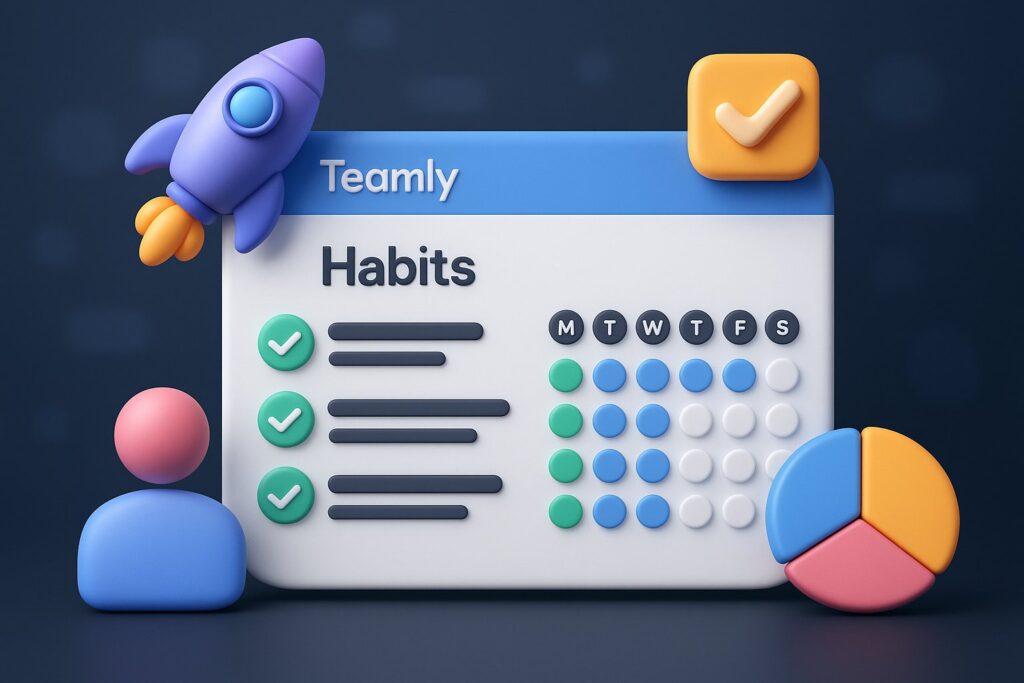
Inside Teamly Business, shared task boards, checklists, and auto-generated status updates keep focus behaviors in plain sight.
When recurring habits like weekly retros or learning blocks live on a platform everyone uses, momentum never depends on memory alone. You don’t have to nag—Teamly politely pings, tracks, and celebrates progress for you.
8. Action Checklist: Start Today
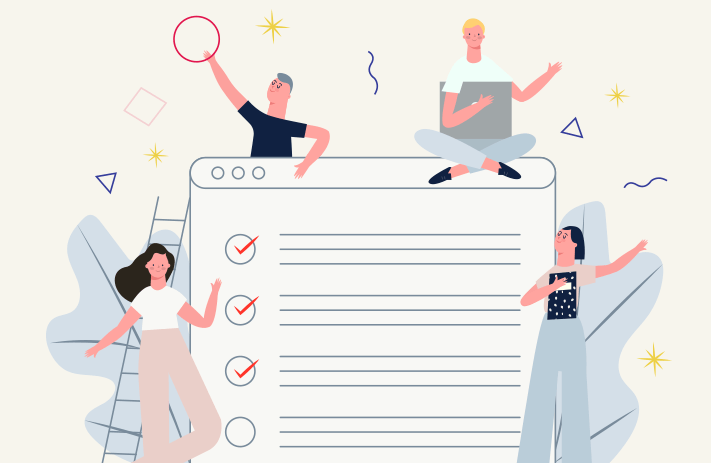
- Run a one-day habit audit and tag behaviors + / – / =.
- Choose one keystone habit to model this week.
- Use Teamly to set a recurring reminder and make progress visible.
- Invite a peer to hold you accountable for consistency.
- Review signals monthly and iterate intentionally.
9. From Slip to Shift: Repairing a Visible Misstep
No leader is perfect. The real test isn’t whether you slip but how you respond when you do.
A visible habit snafu—snapping at a teammate in a tense meeting, for instance—can quickly spread fear or mimicry. Turn that moment into a masterclass by practicing the three-step Slip-Shift-Seal method:
- Slip (own it): Immediately name the lapse. “I raised my voice. That’s not how we solve problems.” Transparency disarms gossip.
- Shift (model repair): Explain the corrective action. “I’m blocking ten minutes with Alex after this call to clear the air and understand their perspective.” Your apology technique becomes part of the culture code.
- Seal (codify improvement): Share the process tweak that prevents recurrence—maybe adopting a “two-breath pause” rule before responding to pushback. By sealing the fix in a small ritual, you prove missteps are growth fuel, not character flaws.
Teams learn that mistakes are data, not doom. Psychological safety skyrockets when the boss rewires in public.
10. Case Snapshot: The 7-Minute Sync That Flattened Silos
At a midsize SaaS org, the engineering director noticed email response times ballooning after feature launches—stress cascaded down the org chart.
Instead of mandating a communication policy, she began every morning with a personal 7-minute sync ritual:
- Stood at an open whiteboard.
- Reviewed yesterday’s blockers aloud.
- Tagged two people to celebrate publicly.
- Outlined one learning goal for the day.
For the first week, only her direct reports showed up. By week three, product managers and a finance analyst wandered in. Within two months, the ritual pulled in 70% of the department. Metrics told the story:
| Metric | Before Ritual | Eight Weeks Later |
|---|---|---|
| Avg. Email Turnaround (hrs) | 12.4 | 5.9 |
| Feature Bug Reports (per sprint) | 17 | 11 |
| Employee eNPS | 58 | 71 |
The director never sent a policy doc. She simply modeled proactive visibility, and the team mirrored it—proving again that habit gravity beats mandate force.
11. Habit Stacking for Leaders: Compounding Influence in Five Minutes a Day
Borrowed from habit-science legend James Clear, habit stacking links a new behavior to an existing reflex. For busy managers, stacking is the cheat code to embed influence without extra hours:
After I open my laptop each morning I will write a 60-second gratitude note to someone who moved a project forward.
After each sprint review I will carve out two minutes to document one lesson in a shared wiki.
Micro-rituals chained to non-negotiable triggers turn culture shaping into muscle memory. Start with a single stack. Once fluent, add another. In six months you’ll have built a silent syllabus your team follows subconsciously.
12. Measuring Momentum: Dashboards That Track Behavior, Not Just Output
Traditional KPIs track what got done, but leading by example means monitoring how. Consider layering a lightweight “behavior dashboard” into your weekly review:
| Signal | Metric | Data Source |
|---|---|---|
| Focus Integrity | % of tasks started without mid-task chat activity | Teamly task + chat logs |
| Learning Pulse | Avg. modules completed per person | LMS export |
| Win Celebration | Shout-outs per week | Slack channel analytics |
Surface the numbers in a quick Teamly widget. Visibility triggers healthy peer pressure and nudges leaders to practice what dashboards preach.
13. Future-Proofing Your Example: Succession Through Ritual
What happens when you go on parental leave or move to a new role?
If the habits you champion vanish, legacy collapses. Protect cultural DNA by ritualizing transfer:
- Document the cadence. A two-page “habit playbook” beats a 40-slide deck.
- Assign a habit steward. Rotate ownership so multiple voices champion the routine, building redundancy.
- Review quarterly. Calendar a 15-minute check-in to refresh purpose and kill rituals that have outlived value.
When habits survive leadership turnover, they transform from personal quirks into institutional strengths.
14. Quick-Start Recap
- Behavioral contagion is real—design the signals you send.
- Audit your visible habits to spot hidden lessons.
- Swap culture-killing traps for keystone routines.
- Use Teamly to broadcast, track, and celebrate the right behaviors.
- Repair slips in public; they’re your best teachable moments.
- Stack micro-habits onto existing triggers to scale influence painlessly.
- Measure momentum with behavior dashboards, not just output KPIs.
Your team’s culture is already learning from every small move you make. Shape that lesson on purpose, and watch trust, productivity, and creativity soar.