

Click the button to start reading
How to Coach Without Becoming a Therapist: Boundaries That Empower Your Team
When a direct report lands in your virtual office again to process feelings about missed deadlines, it’s tempting to play arm-chair psychologist.
Don’t.
Your job is to drive outcomes, not unpack childhood wounds.
The secret is coaching with clear, humane boundaries: plenty of empathy, zero therapy. Done well, you’ll keep projects humming, morale high, and—most important—your sanity intact.

1 | Why Coaching Matters in Project Management
Your project plan may sparkle inside Gantt charts, but execution lives or dies in daily micro-conversations. Effective coaching accelerates:
- Ownership—team members see blockers as theirs to clear, not yours to magically remove.
- Velocity—issues surface early and get resolved fast, shrinking cycle times.
- Engagement—people feel heard, valued, and therefore invested.
Gallup data shows employees who receive regular strengths-centric coaching are three times more likely to do great work. Translation: fewer scope-creep nightmares and fewer 11-p.m. Slack pings for you.
2 | Spotting the “Therapist Trap” Early
The line between supportive manager and unpaid counselor blurs when:
- One-on-ones drift into personal trauma storytelling.
- You feel internal pressure to “fix” someone’s emotional world.
- Project updates morph into endless venting sessions about roommates, landlords, or existential dread.
Coaching focuses on observable behaviors and next actions. Therapy probes deep feelings and past hurts. Keep the distinction sacred.

3 | The E-A-R Framework: Empathy • Autonomy • Responsibility
Use E-A-R to steer conversations back to performance without sounding like a robot:
Empathy: Validate the Feeling
Acknowledge stress, frustration, or ambiguity in one brief sentence. That moment of humanity primes the brain for problem-solving.
Autonomy: Hand Back the Keys
Pivotal question: “What options do you see?” This nudges the teammate from emotional brain to strategic brain—no therapy couch required.
Responsibility: Define the Next Micro-Step
End with clarity: “By Friday, you’ll test the new QA checklist with Priya and Luca.” Everyone leaves knowing who owns what.

4 | Scripts for Eight Tricky Coaching Moments
Below are word-for-word starters. Tweak to fit your voice, then practice until muscle memory kicks in:
- Task Slips
You: “Missed targets can be discouraging; I’ve been there. Which factors were in your control this sprint, and what’s one adjustment you’ll test?” - Emotion Floods a Stand-Up
You: “I hear the hand-off felt abrupt. We’ve five minutes left—what single action do you need from the team today?” - Personal Crisis Erupts
You: “I’m sorry this is weighing on you. While I can’t advise on the personal side, we can rebalance workload. Which tasks can be delegated temporarily?” - Chronic Negativity Loop
You: “I notice we revisit the same blockers weekly. What experiments can you run to test new solutions by next check-in?” - Perfection Paralysis
You: “Delivering 80% this week beats 100% next quarter. What’s the smallest shippable piece we can release Friday?” - Conflict Between Peers
You: “It sounds like priorities clash. Let’s list your shared goal, then have each of you propose two compromises.” - Scope Creep Plea
You: “New requests keep popping up. Which OKR does this support? If none, where should we formally log it for future sprints?” - Career-Growth Angst
You: “You’re eager for bigger stakes—great. Outline a project you could lead start-to-finish. Bring a draft plan next 1:1.”
5 | Embedding Coaching into the Project Lifecycle
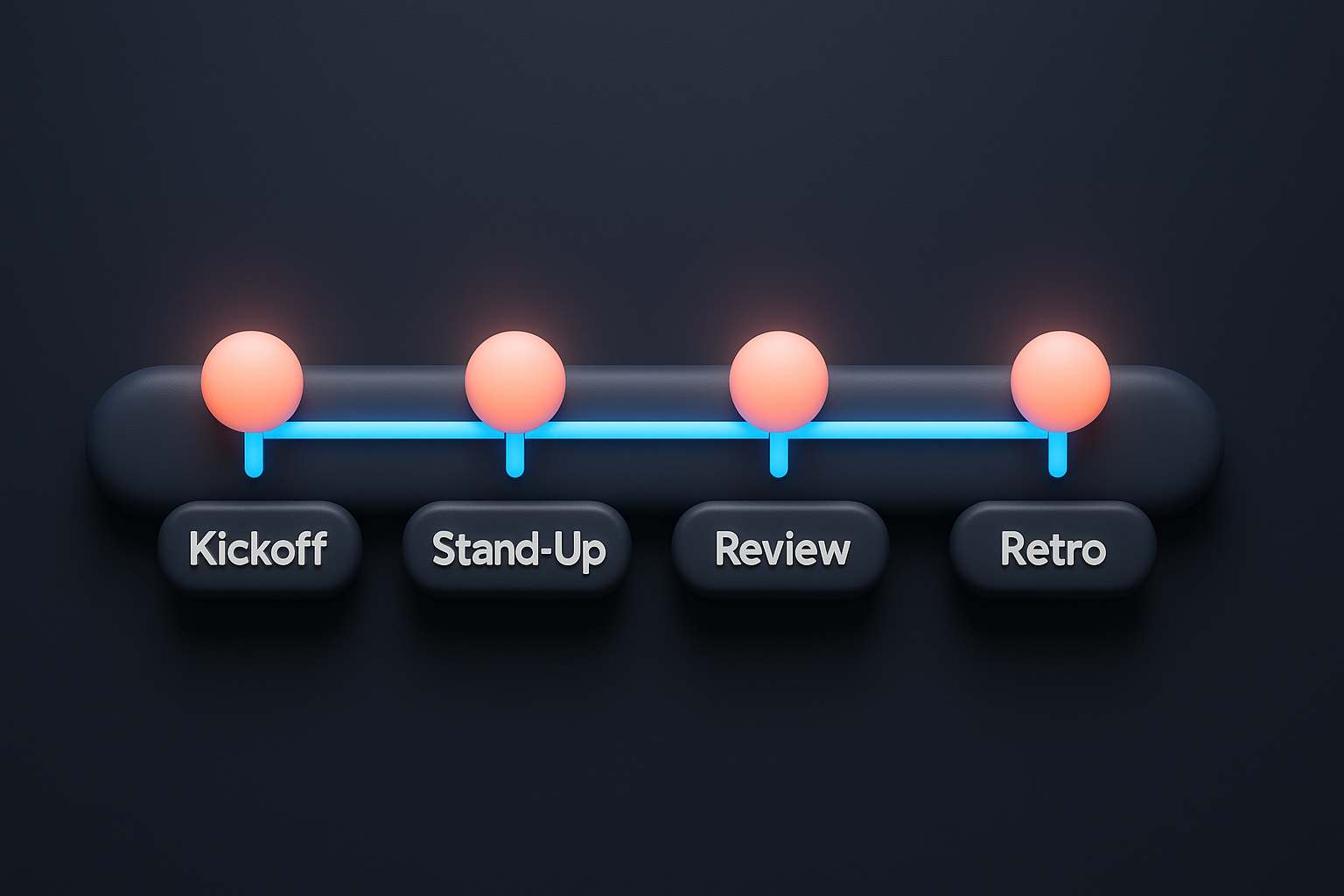
Kickoff
Frame expectations early: highlight the coaching culture and boundary guidelines on day one. It normalizes direct, respectful feedback.
Daily Stand-Ups
Use a “Blockers • Breakthroughs • Next Steps” format. If emotional storms brew, note them for a private sidebar.
Sprint Reviews
Celebrate wins publicly, dissect misses privately. Point lessons toward future experiments, not post-mortem blame.
Retrospectives
Keep retros forward-focused: What will we try next sprint? Avoid forensic rumination that drifts into therapy land.
6 | Tools That Keep Boundaries Crystal-Clear
Digital hygiene reinforces conversational hygiene. Teamly—a lightweight project-management platform—lets you log action items, assign owners, and timestamp decisions in one place. Teammates vent less when tasks and accountability live in transparent dashboards.
Other boundary-boosters:
- Shared Coaching Notes—track commitments in writing so actions outshine emotions.
- Time-Boxed 1:1s—stick to 30 minutes: 10 for rapport, 10 for progress, 10 for roadblocks.
- Calendar “Office Hours”—create drop-in slots for ad-hoc questions, preventing Slack spirals.
- Async Check-Ins—ask for a Monday Loom recording: “What I did • Where I’m stuck • Help I need.” Keeps feelings from hijacking live meetings.
7 | Self-Care for the Coach
- Regular Debriefs—reflect with a peer coach; avoid bottling frustration.
- Resource Lists—have HR, EAP, or mental-health hotlines ready. When topics veer into clinical territory, refer fast.
- Micro-Recovery Rituals—a five-minute walk, 4-7-8 breathing, or stretch resets cognitive load between intense Zooms.
8 | Boundary Scenarios in Hybrid & Remote Teams
Virtual work magnifies ambiguity. Use these tactics to guard lines you can’t physically draw with a closed office door:
Scenario: Slack Confessionals at Midnight
Boundary Move: Pause notifications outside core hours. Respond next business morning: “Let’s tackle this in tomorrow’s 1:1 at 10:00. Bring one idea for moving forward.”
Scenario: Camera-Off Monologues
Boundary Move: Gently ask for a summary doc before live calls. Written reflection trims the emotional excess and focuses on facts.
Scenario: Team-Wide Therapy Session
Boundary Move: Use a rotating “Energy Check” scale (1-5) at stand-up, no elaboration. Deeper support happens in designated coaching slots.

9 | Escalation Pathways: When Coaching Isn’t Enough
Every leader eventually hits topics that belong elsewhere. Your escalation toolkit:
- Safety or Harassment Concerns → loop HR immediately.
- Chronic Burnout Signals → suggest mental-health days and point to Employee Assistance Program.
- Clinical Red Flags (e.g., depression references) → share crisis resources; managers are not clinicians.
- Legal or Compliance Questions → hand off to your legal/compliance partner before advice-giving.
Tip: Create a one-page “Escalation Flowchart” in your onboarding wiki so you’re never guessing under pressure.
10 | Metrics That Prove Your Coaching Works
| Signal | What to Track | Why It Matters |
|---|---|---|
| Delivery Velocity | Sprint points completed vs. planned | Shows if coaching clears blockers |
| Quality | Bug count / escaped defects | Healthy coaching raises craftsmanship |
| Engagement | Pulse-survey “I feel supported” score | Validates empathy without over-coddling |
| Retention | Voluntary turnover rate | Boundaries reduce burnout churn |
Set quarterly targets, then showcase progress in leadership reviews. Hard numbers silence skeptics who equate “soft skills” with fluff.
11 | Micro-Coaching Routines You Can Steal
- Monday Momentum E-Mail—ask each teammate to reply with Week’s One Thing. Reply back with a 20-word nudge.
- Wednesday Walk-N-Talk (audio only)—switch cameras off, walk while you coach. Movement sparks creative problem-solving.
- Friday Fast Retros—five sticky notes: “Keep, Drop, Start, Stop, Shout-out.” Wrap in 15 minutes.
12 | Coaching FAQ: Quick Scripts for Rapid Responses
“I’m overwhelmed.”
You: “List every open task in priority order. Choose one to finish today; we’ll park the rest until tomorrow’s planning block.”
“I want to quit.”
You: “Sounds like things feel heavy. Let’s clarify the core pain point. After we pinpoint it, we can explore options or escalate together.”
“Can I vent for a sec?”
You: “Sure—three-minute timer, then let’s shift to solutions.” (Set an actual timer.)
“Can you mediate my conflict with Alex?”
You: “Happy to facilitate, but first draft a shared goal you and Alex both care about. Bring that to our mediation slot.”
13 | Your Next Move
Coaching without crossing therapeutic lines is an art—and totally learnable. Start small: test the E-A-R framework in your very next one-on-one. Log action items in Teamly so change lives in visible systems. Over time, your team will build resilience, speed, and trust—no couch required.