

Click the button to start reading
Small Gestures, Big Impact: Micro-Actions That Build Team Trust
Blink-and-you-miss-them moments shape how your team feels about you—far more than grand speeches or once-a-year retreats.
When trust hinges on tiny signals, every casual interaction becomes a leadership opportunity.
The good news? You can start practicing trust-building micro-actions this very day, without budget approvals, time-consuming rollouts, or a personality transplant.
Ready to amplify trust through the smallest of gestures? Let’s dive in.

Even the briefest gesture can strengthen the invisible bridge between teammates.
1. Why Micro-Actions Matter More Than You Think
Teams don’t assess you once a quarter; they evaluate you in real time.
Eye contact during stand-ups, the tone used in chat replies, the speed of follow-up—each interaction tells a story about reliability, care, and respect.
Because these behaviors repeat dozens of times daily, their impact compounds, silently coding the cultural DNA of the team.
The Compounding Effect
Trust grows (or shrinks) like compound interest.
One supportive comment may seem insignificant, yet multiply it by 200 workdays and eight daily touchpoints, and you’ve woven a fabric of psychological safety.
Emotional Contagion
Neuroscience shows that micro-behaviors trigger mirror-neurons: a quick smile encourages a return smile; a curt reply can set off stress hormones.
Micro-actions therefore ripple across the team’s emotional climate—positively or negatively—within seconds.
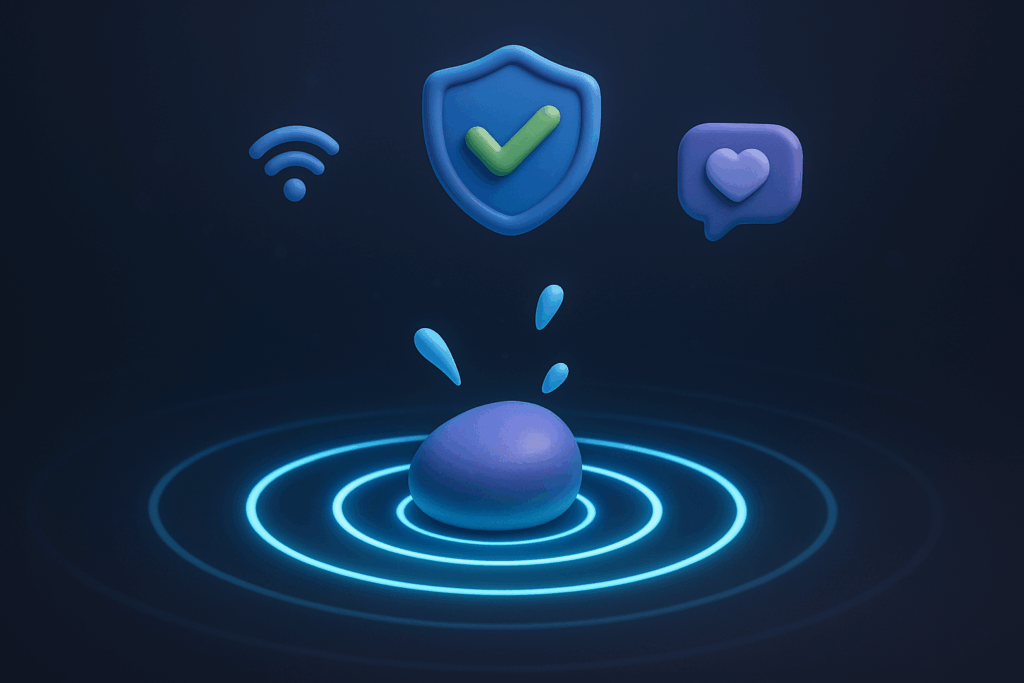
Like ripples in a pond, your micro-actions fan out through the team’s day.
2. The Micro-Action Framework: O-S-R
O-S-R = Observe • Signal • Reinforce
Observe: Notice moments that carry emotional weight—a teammate shares a roadblock, a new hire speaks in a meeting, a bug report causes weekend work.
Signal: Offer an immediate, concrete cue of respect or support. Think: nodding, concise gratitude, or sending a resource link.
Reinforce: Close the loop later—celebrate the fix, reference their contribution, or note the lesson learned.
This loop cements credibility because it shows you’re present, you care, and you remember.
3. Daily Micro-Actions for Managers
Acknowledge Effort in the Moment
When you see someone debug a tricky issue, pause the screen share and say, “You’ve navigated three layers of legacy code in ten minutes—stellar focus.”
Specific praise beats vague applause, imprinting the belief that you truly notice.
Share the Mic
In meetings, redirect a question: “Let’s hear Maria’s perspective—she’s closest to the customer.”
This tiny diversion signals trust in expertise and models inclusive authority distribution.
Keep Micro-Promises
Whether you pledged to send a deck “by EOD” or to look into PTO policies, deliver exactly as stated.
Each fulfilled micro-promise reinforces the expectation that your word equals action.
Visible Preparation
Arrive with the doc open, relevant data pulled, and next steps drafted.
Colleagues sense that you value their time, and the meeting’s pace instantly elevates.
Close Loops Quickly
After decisions, drop a concise recap: “Bug #126 is prioritized for Sprint 12; Anna will lead; ETA Wednesday.”
Rapid clarity crushes uncertainty—the nemesis of trust.

Trust flourishes through consistent, bite-sized behaviors.
4. Embedding Micro-Actions into Your Workflow
Use Meeting Rituals
Begin each stand-up with a 30-second “Win & Thanks” round—teammates share one success and thank a peer.
Ritual turns micro-actions into muscle memory.
Leverage Digital Nudges
Tools like Teamly let you automate check-ins, birthday shout-outs, or kudos channels.
When reminders surface inside your existing workflow, consistency goes up and friction drops.
Create Personal Triggers
Pair a micro-action with a habitual event: after sending a Slack message, re-read tone before hitting enter; every time you open your calendar, ask “Who needs an acknowledgment today?”
Behavioral pairing engrains new habits without cognitive overload.
5. Micro-Actions for Remote & Hybrid Teams
When cameras flicker off and hallway chats disappear, trust can erode in the silence between calls. Distributed teams therefore need micro-actions with a little extra wattage—gestures that travel well through pixels and time-zones.
Over-Communicate Context
Add one sentence of rationale whenever you share a decision asynchronously. “We’re shipping today to avoid Friday deploy-freeze.” That tiny context line prevents spirals of Slack speculation and demonstrates transparency—a cornerstone of remote trust.
Use the Five-Minute Tail
Schedule 55-minute meetings, then reserve the final five minutes expressly for unstructured connection. Ask a fun prompt (“Show a desk object that sparks joy”) or invite questions about the project plan. Regular mini-buffers replace lost water-cooler time without ballooning calendars.
Emoji as Emotional Indicators
Encourage teammates to react with 🌱 (need guidance) or 🚀 (ready to go) in project threads. These low-friction signals surface sentiment that might otherwise remain hidden behind muted microphones.
Spotlight Time-Zone Wins
When an off-hours teammate finishes a key task overnight, call it out in your morning update. It shows their invisible labor is seen and valued, which tightens bonds across continents.
6. Case Studies: Tiny Gestures, Massive Turnaround
Case Study #1 – The 15-Second Video Check-In
A mid-size SaaS support team struggled with siloed knowledge and slipping CSAT scores. Their manager asked every agent to record a 15-second Loom at shift end answering, “What did I learn today that could help the squad?” After two weeks, the backlog time shrank 12% and peer-to-peer solution sharing increased three-fold.
Why it worked: The micro-video signaled expertise respect, created lightweight documentation, and sparked mutual appreciation threads—each a trust deposit.
Case Study #2 – The Gratitude Slack Bot
In a manufacturing company’s hybrid R&D unit, morale dipped when post-pandemic expansion scattered colleagues across three sites. The engineering lead deployed a Slack bot that nudged one employee daily to send a public thank-you.
The note had to cite a specific behavior (“saved my prototype by overnight-printing a bracket”). Within one quarter, engagement-survey scores on “I feel recognized at work” jumped from 62 % to 88 %.
Why it worked: The automation removed cognitive load, the specificity kept praise credible, and public visibility created contagious positivity.

Digital nudges keep trust-building gestures on autopilot.
7. Measuring the Lift: Trust Signals to Track
Pulse Surveys
Run a two-question weekly pulse:
“I feel safe taking risks on this team.”
“I trust my manager to follow through.”
Watch the trend line rather than one-off scores.
Slack Sentiment Analysis
Many analytics plugins surface emoji ratios (“👍” vs “😬”) and response times.
More positive reactions and quicker replies often correlate with rising trust.
Meeting Participation
Track voice-time distribution. If newer voices steadily increase, micro-actions are widening the floor.

Simple metrics reveal whether your micro-actions are paying dividends.
8. Avoiding Micro-Action Pitfalls
Performative vs. Genuine
Teammates detect insincerity fast. Tie every micro-gesture to a real belief—otherwise it feels like brand-building theater.
Inconsistency Erodes Faster Than Neglect
Sporadic praise can backfire, creating confusion about what drives recognition.
Consistency, not extravagance, sustains trust.
Forgetting Cultural Context
A thumbs-up emoji may delight one teammate and puzzle another.
Adapt gestures to individual preferences and cultural norms to keep signals crystal clear.
9. Your Trust-Building Toolkit
- One-Minute Journaling: At day’s end, jot three micro-actions you delivered. The diary primes you for tomorrow.
- Weekly “Trust Check” Meeting: Five minutes dedicated to asking, “Where did we nail trust? Where did we miss?”
- Automated Kudos with Teamly: Use Teamly’s lightweight workflow to schedule recurring prompts that encourage peer recognition.
- Personal Triggers: Pick one habitual activity (opening email, logging into the code repo) and attach a micro-action reminder.
Trust isn’t an off-site objective; it’s built or broken in milliseconds throughout the day.
When you harness the power of micro-actions—observing, signaling, reinforcing—you transform fleeting moments into the bedrock of team cohesion.
Start small, stay consistent, and the big impact will follow.