


Click the button to start reading
The Manager’s Toolbox: Simple Planning Frameworks That Actually Work
You don’t need a three-ring circus of spreadsheets to steer your team toward its goals.
A handful of straightforward frameworks—each laser-focused on a different horizon—can help you cut through the noise, make confident decisions, and keep momentum high.
Below you’ll find a manager’s “greatest hits” playlist: the Eisenhower Matrix for ruthless daily prioritization, the 90-Day Plan for medium-range execution, and the Daily Stand-up for real-time alignment.
Grab the tools that fit your context, plug them into your favorite work OS (Teamly’s templates make this fast), and watch clarity spread through every project.
Why Simple Beats Complicated
Complex systems promise nuance but often deliver paralysis. The most reliable frameworks share three traits:
- Visual clarity — a one-glance signal of what matters most.
- Rhythmic cadence — built-in checkpoints that create healthy pressure without micromanagement.
- Behavioral friction — just enough structure to nudge better habits without locking creativity in a cage.
Pick the rhythm that matches the altitude of your decision. Then let repetition cement the habit across your team.

The Eisenhower Matrix: Four Quadrants, Zero Excuses
What It Is
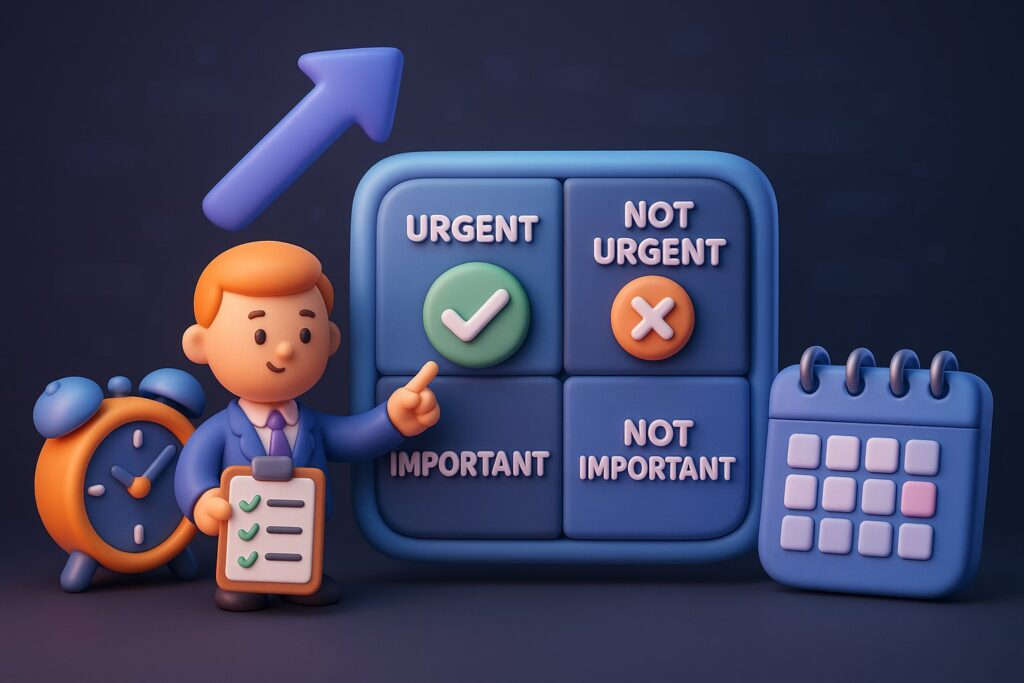
The Eisenhower Matrix sorts your to-dos into four simple buckets: Urgent & Important, Important but Not Urgent, Urgent but Not Important, and Neither. Every task meets its fate the moment you assign it a quadrant.
When to Use It
- When your inbox explodes and you’re tempted to tackle whatever screams loudest.
- At the start of each workday to carve a realistic action list.
- With direct reports during one-on-ones to coach smarter prioritization.
How to Run It
- Dump every open task onto a scratchpad.
- Label each task with U = Urgent, I = Important, both, or neither.
- Plot on the matrix, then make ruthless calls: Do (U+I), Schedule (I only), Delegate (U only), or Delete (neither).
- Transfer only the top three “Do” items to today’s calendar block.
Tip: Pair the matrix with a 15-minute planning buffer at day’s end. Tomorrow’s tasks will greet you sorted, not screaming.

The 90-Day Plan: Turn Strategy into Sprints
What It Is
A 90-Day Plan bridges lofty annual OKRs and the messy reality of weekly work. It defines one to three high-leverage objectives, each backed by clear success metrics and milestone checkpoints every 30 days.
When to Use It
- At quarter kicks—tie fresh resources to sharp focus.
- After a pivot—translate new direction into measurable wins.
- With emerging leaders—teach structured execution without overwhelming detail.
How to Run It
- Draft objectives that move the needle on company-level goals (SMART works, but sharper is better).
- Break each into three 30-day increments: Ramp, Run, Refine.
- Assign cross-functional owners, expected outputs, and leading indicators.
- Sync progress in bi-weekly reviews; course-correct before drift calcifies.
The Daily Stand-up: 10 Minutes to Realign Reality
What It Is
A lightning-round meeting where every team member answers three prompts: Yesterday I…, Today I’m…, Blocked by…. Standing literally (or figuratively) keeps momentum brisk and minds sharp.
When to Use It
- In fast-moving product or marketing squads where blockers cost money.
- During crunch periods—launch weeks, campaign sprints, critical fixes.
- With distributed teams to maintain connection across time zones.
How to Run It
- Cap attendance to the core working group; observers stay silent or review the notes later.
- Rotate facilitation—everyone feels accountable.
- Park discussions that drift; tackle them in micro-huddles right after.
- Track blockers publicly, assign owners, and follow up by day’s end.
Consistency beats charisma: a reliable 9:05 a.m. stand-up trains brains to surface issues early, preventing schedule-wrecking surprises.

Stitching the Frameworks Together
Think of these tools as concentric circles of focus:
- Daily Stand-up keeps work flowing hour-to-hour.
- Eisenhower Matrix filters noise before it clogs the stand-up pipeline.
- 90-Day Plan ensures today’s movement ladders up to tomorrow’s milestone.
Layering them yields a system where long-term vision, tactical priorities, and real-time execution reinforce one another. The result? Fewer fire drills, more strategic wins, and a calmer, confident team culture.
Common Pitfalls (and Fast Fixes)
| Framework | Typical Misstep | Correction |
|---|---|---|
| Eisenhower Matrix | Everything feels urgent | Force-rank by objective impact before urgency |
| 90-Day Plan | Goals too ambitious or vague | Limit to three and attach numeric targets |
| Daily Stand-up | Turns into status monologue | Time-box each speaker to 60 seconds |
Metrics That Matter (and the Psychology Behind Them)
Plans feel motivating only when people can see their effort convert into progress.
That’s why every framework deserves a tight pairing of leading and lagging indicators.
Leading metrics (think: story points closed, prospects contacted, test suites passed) provide early signals that momentum is healthy.
Lagging metrics—revenue, new-user activations, defect-escape rate—prove the effort was worth it. Surface both in a single glance: a dashboard tile, a wall chart, or a quick Teamly widget beside each milestone.
This dual visibility triggers a powerful feedback loop: early successes fuel dopamine and keep the group invested; clear lagging wins anchor confidence that the system works.
Skip either metric and the human brain fills the void with anxiety or apathy.
Equally important is the cadence of review. Weekly check-ins on leading indicators prevent “silent drift,” while monthly retrospectives on lagging numbers encourage strategic tweaks without knee-jerk pivots.
Celebrate tiny spikes publicly—even a two-percent improvement in stand-up blocker clearance—because micro-recognition multiplies adoption faster than any mandate.
Tool-Stack Tips: Make the Frameworks Stick
Good intentions vanish when friction is high, so bake your toolbox into the apps your team already lives in. A few starter moves:
- Digital quadrant board — Pin a shared Eisenhower Matrix at the top of your Teamly workspace. Auto-archive completed tasks each Friday to keep the grid uncluttered.
- Calendar sync — Convert 90-Day Plan milestones into calendar holds. This acts as a visual countdown timer—very hard to ignore when it stares from tomorrow’s agenda.
- Stand-up bot — Use a simple chatbot or a Teamly automation to ping each member for their three stand-up answers before the meeting, trimming live time to under ten minutes.
- Progress nudges — Pair each framework with lightweight reminders: a Monday “set your quadrant” alert, mid-sprint milestone check-ins, and Friday “share a win” prompts.
When the infrastructure disappears into everyday workflows, the frameworks graduate from “extra step” to “how we operate.”
That’s the sweet spot where planning transforms from paperwork into predictable, repeatable execution.
Next Steps: Your 48-Hour Implementation Sprint
- Block 30 minutes tomorrow morning to draft an Eisenhower Matrix for your top ten tasks.
- Book a 90-minute workshop this week—map one 90-Day Plan for your highest-stakes initiative.
- Launch a Daily Stand-up pilot with your immediate team for the next five workdays.
- Log the experiments in Teamly so success metrics and reflections live in one place.